Quick answer: the best trading psychology books for most traders are Mark Douglas’s Trading in the Zone for the core mindset, Brett Steenbarger’s The Daily Trading Coach for practical self-coaching, and Daniel Kahneman’s Thinking, Fast and Slow for the cognitive science underneath both.
Most traders lose money not because their strategy is wrong, but because they can’t execute it consistently under pressure — cutting winners early, holding losers too long, revenge trading after a bad session. That’s a psychology problem, not a strategy problem, and it’s the one area where the right book genuinely helps. Below are six of the most widely recommended trading psychology books, reviewed for what each one actually teaches so you can pick the one that fits where you are.
Quick Comparison of the Best Trading Psychology Books
| Book | Author | Best for |
|---|---|---|
| Trading in the Zone | Mark Douglas | The core mindset: thinking in probabilities |
| The Disciplined Trader | Mark Douglas | Understanding why discipline is so hard |
| The Daily Trading Coach | Brett Steenbarger | Practical, day-by-day self-coaching |
| Trade Your Way to Financial Freedom | Van K. Tharp | Linking psychology to position sizing |
| Thinking, Fast and Slow | Daniel Kahneman | The cognitive biases underneath it all |
| Best Loser Wins | Tom Hougaard | Accepting losses and trading without fear |
1. Trading in the Zone — Mark Douglas
The most frequently recommended trading psychology book, and the usual starting point. Douglas’s central argument is that consistent results come from thinking in probabilities: any single trade’s outcome is essentially random, but a strategy with an edge pays off over a large enough series if you execute it the same way every time. The book is less about charts and more about accepting uncertainty, defining risk before entering, and not letting one trade’s outcome distort the next decision. If you only read one book on this list, this is the common choice.
2. The Disciplined Trader — Mark Douglas
Published in 1990, this is Douglas’s earlier work and one of the first trading books to focus heavily on the psychological side rather than methodology. It digs into why discipline is so difficult — how the mental habits that serve us in everyday life work against us in the markets. It’s more foundational and, some readers find, denser than Trading in the Zone; worth reading second if the first book resonates and you want the deeper groundwork.
3. The Daily Trading Coach — Brett Steenbarger
Dr. Steenbarger is a trained psychologist who has worked directly with professional traders, which makes this the most hands-on book on the list. It’s structured as 101 short lessons, each a self-contained technique you can apply to coach yourself through a specific problem — tilt, hesitation, overtrading. Because it’s modular, it works well as a book you return to when a particular issue shows up in your own trading rather than one you read cover to cover once.
4. Trade Your Way to Financial Freedom — Van K. Tharp
Dr. Tharp’s contribution is connecting the psychological and the mechanical: the idea that there’s no single “right” system, only a system that fits you, and that position sizing and expectancy matter more than entry signals. It introduces widely used concepts like R-multiples (measuring gains and losses as multiples of your initial risk) and thinking about a strategy’s expectancy over many trades. Best for traders who want the bridge between mindset and money management — our guide to position sizing and risk per trade covers the mechanical side that Tharp’s psychology sits on top of.
5. Thinking, Fast and Slow — Daniel Kahneman
Not a trading book at all — it’s a behavioral psychology book by Daniel Kahneman, who won the Nobel Prize in Economics in 2002 for the work behind it. It’s on this list because the biases it documents are precisely the ones that damage trading accounts: loss aversion (losses hurt more than equivalent gains feel good), overconfidence, and the tension between fast, intuitive “System 1” thinking and slow, deliberate “System 2” thinking. Read it when you want to understand the why beneath the trading-specific advice in the other books.
6. Best Loser Wins — Tom Hougaard
A more recent and more personal book from a trader known for trading large size. Its theme is captured in the title: the traders who last are the ones who lose well — who accept losses quickly and without ego rather than fighting them. It’s less academic than Kahneman or Tharp and reads more like hard-won experience, which some traders find more motivating and others find less rigorous. A good change of pace after the more structured books above.
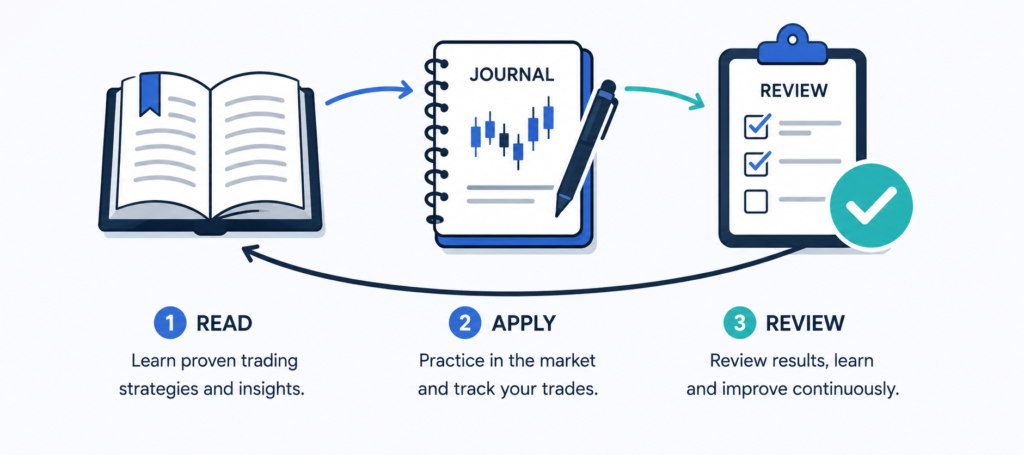
How to Actually Get Value From These Books
Reading a trading psychology book and nodding along changes very little — the ideas only matter when you apply them to your own trades. Three ways to make that happen:
- Read alongside a trade journal. When a book names a pattern (say, cutting winners early), look for it in your own recorded trades. Recognizing it in your history is what makes the concept stick.
- Pick one idea per book, not ten. Trying to fix everything at once fixes nothing. One concrete behavioral change per book, tested over a series of trades, beats a highlighter full of insights you never act on.
- Re-read after screen time. These books land differently once you’ve felt the emotions they describe. A chapter that seemed obvious before you’d taken a painful loss often reads completely differently afterward.
For a look at how these mindset principles play out in practice across different markets, see our piece on trading psychology trends in Western forex markets.
Key Takeaways
- Start with Trading in the Zone for the core probabilistic mindset; it’s the most common first recommendation among the best trading psychology books.
- Use The Daily Trading Coach as a practical, dip-in reference for specific problems; use Thinking, Fast and Slow for the cognitive science underneath.
- No book replaces screen time — pair each with your own trade journal and change one behavior at a time.
Frequently Asked Questions
What is the best trading psychology book for beginners?
Mark Douglas’s Trading in the Zone is the most common starting recommendation, because it focuses on the mindset shift of thinking in probabilities rather than on any specific market or strategy.
Do trading psychology books actually make you a better trader?
A book can’t replace screen time, but it can shorten the learning curve by naming the mental patterns that cause avoidable mistakes. Reading without applying the ideas to your own trading changes little.
Is Thinking, Fast and Slow a trading book?
No — it’s a behavioral psychology book by Nobel laureate Daniel Kahneman, not about trading specifically. It’s included here because the cognitive biases it describes (loss aversion, overconfidence) are exactly the ones that hurt traders.
In what order should I read these trading psychology books?
A reasonable path: start with Trading in the Zone for the core mindset, then The Daily Trading Coach for practical self-coaching, and read Thinking, Fast and Slow when you want the deeper why behind the biases.